Trees in New Albany give the city its texture: maples lining Limerick Lane, old oaks shadowing early 1900s brick homes near State Street, the occasional silver maple that drops a lifetime of seeds into your gutters. When those trees need attention — removal, trimming, stump removal, transplanting — the decision about who to hire is practical and residential tree service New Albany personal. You want safety, value, and respect for the landscape, not just the cheapest crew with a chainsaw. This guide walks through the judgments that matter, the questions to ask, and the subtle differences between competent tree care and risky shortcuts, with examples you can use when you search for tree cutting near me in New Albany.
Why local matters
Local crews understand the microclimate and common species in southern Indiana. Elm and ash issues look different here than in northern Indiana or Louisville. A crew that has worked in New Albany knows which species resist pruning, which sprouts back quickly, and what storm damage typically looks like after a summer thunderstorm. That local experience matters when the work affects structures, utilities, and the neighborhood canopy.
Safety and liability: what to verify first
Chainsaws, bucket trucks, and top-heavy trees near roofs are a liability if a crew is underinsured or untrained. Ask for certificates that demonstrate current insurance: general liability and workers compensation are minimums. If a contractor claims they are a sole proprietor with no employees, still insist on proof of personal liability coverage. A local example: after a storm in 2019, a small crew felled a cottonwood that swung into a neighboring garage. The crew lacked adequate liability insurance and the homeowner spent months on a claim that could have been avoided.
Licensing requirements are not uniform across counties, so focus on competence instead of a single license. Many reputable arborists carry certification from the International Society of Arboriculture, listed as ISA Certified Arborist. That credential indicates training in tree biology, pruning techniques, and safe rigging. Cummins Tree Service, for example, advertises local experience and often lists certifications and references; verifying those claims is a smart early step.
Two quick checklists to use when vetting crews
If you want a short set of practical questions to ask on the initial call, use this five-item checklist.
- Are you insured for general liability and workers compensation, and can you provide certificates? Do you hold ISA certification or equivalent training, and can you provide references from New Albany jobs? Will you provide a written estimate that itemizes labor, equipment, stump removal, and disposal? Do you plan to grind the stump, mechanically remove it, or leave it? What are the costs for each option? What is your timeline and how do you handle unexpected findings, like rot or buried utilities?
Watch for these four red flags during the estimate or on-site visit.
- A verbal quote only; insist on written estimates to avoid scope creep. No safety gear or obvious lack of rigging equipment; that is a sign of corners being cut. Pressure to accept immediately or a very low initial deposit demand; reputable crews usually take payments staged to milestones. No local references or unwillingness to show previous work in the area.
Estimating cost: what drives the price
When a crew quotes tree trimming services or removal, several variables determine cost. Size is the obvious one: diameter at chest height and overall height multiply effort. But other factors can equal or exceed size in cost. Is the tree over a house or power line, requiring precision cuts or a crane? Is access tight, with a narrow driveway or overhead wires? Is there a risk of damage to brick, ornamental beds, or a swimming pool? Expect to pay more when the work demands slow, controlled lowering of large sections.
For stump removal, there are two common methods. Mechanical grinding pulverizes the root flare and main roots to a depth usually between 6 and 24 inches, depending on the grinder. That leaves the root network to decay naturally and requires minor backfill. Full root removal digs out the stump and major roots; it is more labor intensive, creates a larger hole to fill, and costs significantly more. If you intend to plant a new tree in the same spot, full root removal can make sense. If you only want a clean lawn, grinding typically suffices.
Transplanting trees is specialist work and often misunderstood. Small specimens up to 2 to 3 inches caliper can be moved successfully in spring or fall by crews with the right balling-and-burlapping techniques. Larger trees require mechanical root pruning months in advance, a tree spade, and coordinated aftercare including staking and irrigation. If a contractor offers to "replant" a mature tree without showing a plan for root preservation, consider that a warning.
Qualitative measures of competence
Beyond documentation and price, evaluate a crew by how they approach the job on-site. Are they tidy with clear paths for equipment? Do they discuss the sequence of cuts and containment for debris? An experienced foreman will examine the tree, identify potential hazards such as decay or cavities, and explain options rather than insist on a single approach.
Look for attention to tree health as well as immediate objectives. Proper pruning removes deadwood first, then shapes the canopy to maintain wind resistance and structural integrity. Over-pruning, often called topping, is a red flag. It causes weak regrowth and invites pests and disease. Another subtle competence marker is how they handle utility lines. Trimming near power lines requires coordination with the utility company; a crew that promises to "just trim it" without utility notification is taking a risk that can become costly or dangerous.
Understanding quotes and contracts
A clear contract should outline scope, price, payment schedule, completion timeline, and cleanup responsibilities. Request itemized pricing for tree removal, trimming, stump removal, and optional services like chipping and hauling. If the bid is low but cleanup is not included, the price will rise when the crew asks to be paid extra to remove brush and wood. Also clarify who is responsible for municipal permits if required. Some municipalities require permits for large removals or for work in the public right of way.
Many reputable crews collect a modest deposit, typically no more than 20 to 30 percent, with final payment due on completion. Avoid paying the full amount upfront. If a contractor asks for payment in cash only or pressures you to sign a blank release, refuse and walk away.
When to use a crane or specialty rig
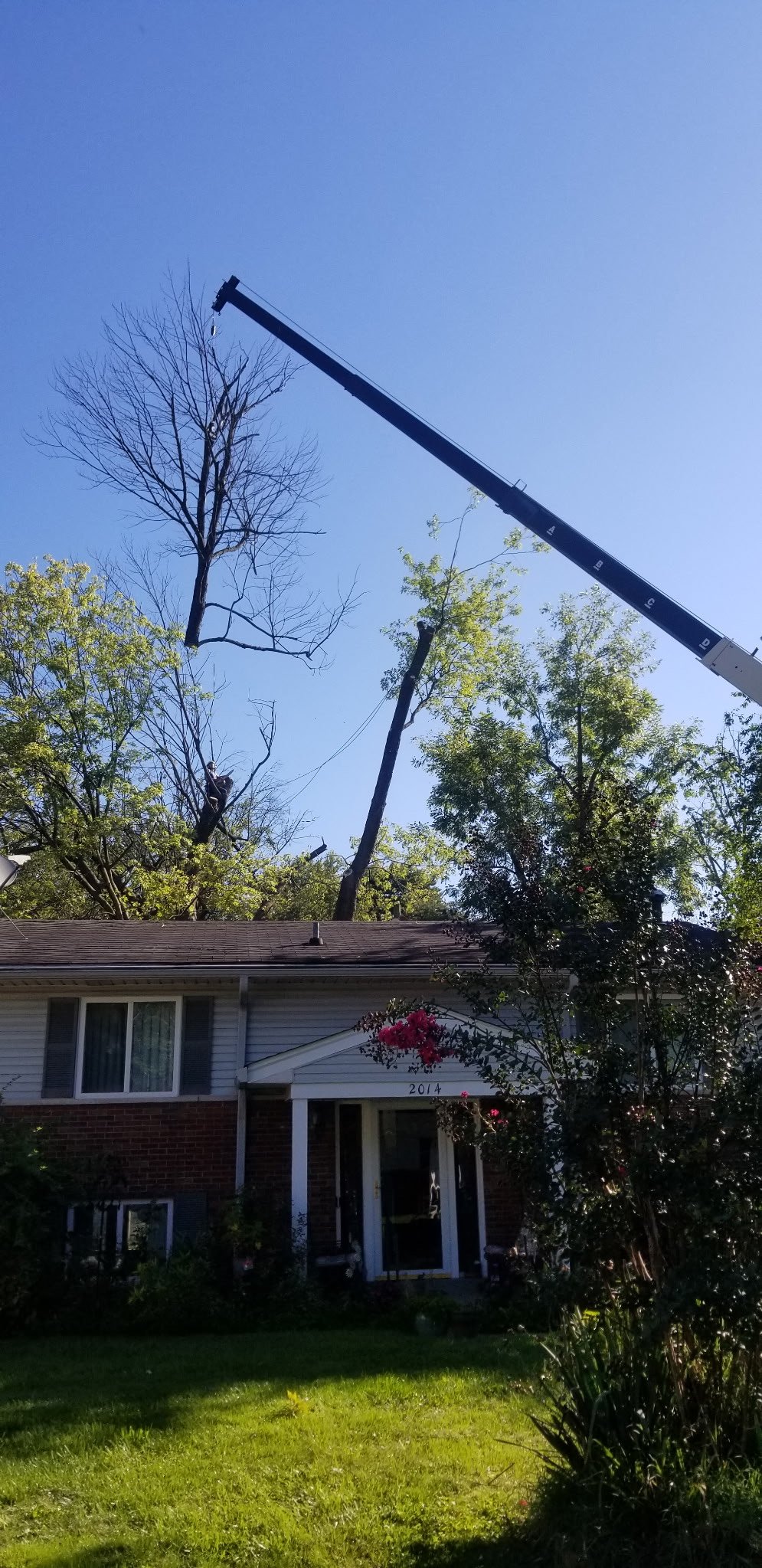
Crane-assisted removal is more expensive per hour, but it can be the safest and fastest option when a large tree sits near a house, power line, or delicate hardscape. I once observed a crane removal in New Albany for a 90-foot oak within 12 feet of a historic bakery. The crane allowed sections to be lifted straight up and lowered into a truck, minimizing collateral damage. The extra cost was justified by reduced time on-site and no damage claims afterwards.
If the crew suggests a crane, ask about their experience and whether they subcontract crane operators. A single crew that handles both rigging and cutting simplifies communication, but subcontracted work is common. Ensure all parties listed on the contract have proper insurance.
Environmental and neighborhood considerations
Removing a tree affects microhabitats and stormwater patterns. If a large tree shades a rain garden or anchors a slope, losing it can increase runoff and change how a yard drains. Consider whether pruning or transplanting could meet objectives without full removal. Some homeowners have successfully combined partial crown reduction with selective transplanting of smaller accent trees to maintain canopy cover.
Also be mindful of municipal rules and neighborhood expectations. Some New Albany neighborhoods have historic overlay districts with restrictions on tree removal. If your property sits near a protected area or local easement, talk to the city before work begins. A well-informed contractor will know these rules and factor them into the estimate.
Practical maintenance after the cut
Once the tree is down and the stump ground, plan for post-work care. Freshly cut surfaces on remaining trees should receive clean cuts; jagged or torn bark invites disease. If the crew prunes poorly, insist on corrective work or a partial refund. For planted replacements, install a simple drip irrigation system for the first two summers. Newly planted trees can lose 30 to 50 percent of their root systems during transplanting and need consistent moisture and mulching to reestablish.
Expect some settling in the soil where a stump was ground. Fill low spots with good garden soil and compact lightly in layers rather than dumping soil and expecting it to stay. If you plan to plant lawn seed, allow several months for the wood chips to decompose or bring in fresh topsoil to avoid nitrogen drawdown that can stunt grass growth.
Timing and seasonal considerations
The best time for vigorous pruning and transplanting in our region is late winter to early spring, before leaf-out. Tree removal can happen year-round, but winter offers advantages: frozen ground improves equipment access and reduces turf damage. Storm season in June through August can produce urgent needs; reputable crews often keep a portion of capacity for emergency work, but expect longer lead times during major storm events.
Selecting a long-term partner
If you own multiple properties or plan ongoing maintenance, think in terms of a relationship rather than a one-time contractor. A trustworthy tree service will track the pruning cycle for your property, typically every three to five years for mature trees. They will provide written recommendations and records of past work. Cummins Tree Service and similar local businesses often maintain client lists and can schedule recurring visits, which helps preserve canopy health and reduces emergency removals.
A final practical example
I helped a neighbor coordinate removal and replacement after a sugar maple split in a windstorm. We interviewed three crews, each offering different plans. The cheapest option removed the tree and left the stump for someone else to handle. The middle option included stump grinding and moderate cleanup. The third, slightly more expensive option, combined careful sectional removal near the garage, stump grinding, and planting of a young tulip poplar with a two-year maintenance check. We chose the third because it minimized risk to the garage and returned canopy value faster than letting the site sit empty. The added cost represented about 15 percent of the total estimate, but it saved weeks of hassle and a follow-up call to insurance later.
Finding "tree cutting near me" in New Albany
When you perform a local search, look beyond star ratings and photographs. Call and ask the practical questions listed earlier. Request a site visit. Compare itemized bids and timelines. Ask for references from nearby jobs. If Cummins Tree Service appears in your search results, verify their insurance and ask for local references. Small, reputable outfits often outperform larger national chains when it comes to neighborhood knowledge and personal accountability.
Your decision should balance safety, tree health, and value. A low price rarely compensates for a careless cut or skipped permit. Conversely, the most expensive bid is not automatically the best. Use the criteria here to judge competence: clear written contracts, appropriate insurance, experienced crews, and sensible recommendations that preserve long-term tree health when possible. With the right crew, tree cutting in New Albany becomes an investment in property and neighborhood character, not just a problem to solve.
Cummins Tree Service
10245 Lotticks Corner Rd SE, Elizabeth, IN 47117
(502) 492-4208
[email protected]
Website: https://cumminstreeservice.com/